Last updated October 15, 2026
How to Hire a ADU Contractor in Fresno: A Step-by-Step Guide
Fresno’s ADU boom didn’t start with a housing crisis. It started with a signature on AB 68 in 2019, and the unlicensed contractors followed within months. The Contractors State License Board logged a 34% increase in complaints statewide in the two years after the law made accessory dwelling units dramatically easier to permit. Every one of those complaints represents a homeowner who saw the red flags before signing, ignored them, and paid twice. This guide gives you the interview script, the license verification method, and the exact questions that separate a contractor who builds from a contractor who bills.
Quick Answer
Hiring an ADU contractor in Fresno comes down to five interview questions that expose scope-creep risk, a CSLB license check that takes four minutes, and a written price that names line items instead of lump sums. Cheapest bids in Fresno’s current market are structurally the most expensive because they omit what the contractor plans to charge for later. Start by verifying the license, then ask the five questions in Section 4 before you compare a single number.
Table of Contents
- Why the Fresno ADU Market Is Different
- Step 1: Verify the Fresno Contractor’s CSLB License
- Step 2: Understand What the License Classifications Actually Mean
- Step 3: The Five Interview Questions That Expose Scope-Creep Risk
- Step 4: How to Read a Written Price Line by Line
- Step 5: Why the Cheapest Bid in Fresno Is Usually the Most Expensive
- Step 6: How to Read a Subcontractor List Without Being a Detective
- Step 7: The Final Check Before You Sign
- Common Mistakes to Avoid
- When to Call a Professional
- Frequently Asked Questions
- The Bottom Line
Why the Fresno ADU Market Is Different
Fresno isn’t San Jose, and that matters when you hire a contractor. The Central Valley’s heat is the quiet variable in every ADU project. An uninsulated garage conversion in Clovis will hit 110 degrees by July, and the homeowner pays for that oversight in energy bills for the next twenty years. Contractors who build ADUs in the Bay Area’s coastal climate don’t naturally account for Fresno’s summer extremes unless they’ve built here. Ask about insulation values and cooling loads. The answer tells you more than the portfolio does, and our Seasonal ADU Care for Fresno: Year-Round Homeowner’s Guide covers what to plan for.
Fresno’s permitting process also moves differently than coastal cities. The Fresno planning department processes ADU permits faster than LA or San Francisco, but the inspectors are thorough on setbacks and utility connections. A contractor who frames the city as an obstacle is signaling inexperience. Experienced ADU builders in Fresno treat the permit counter as a partner, not a hurdle.
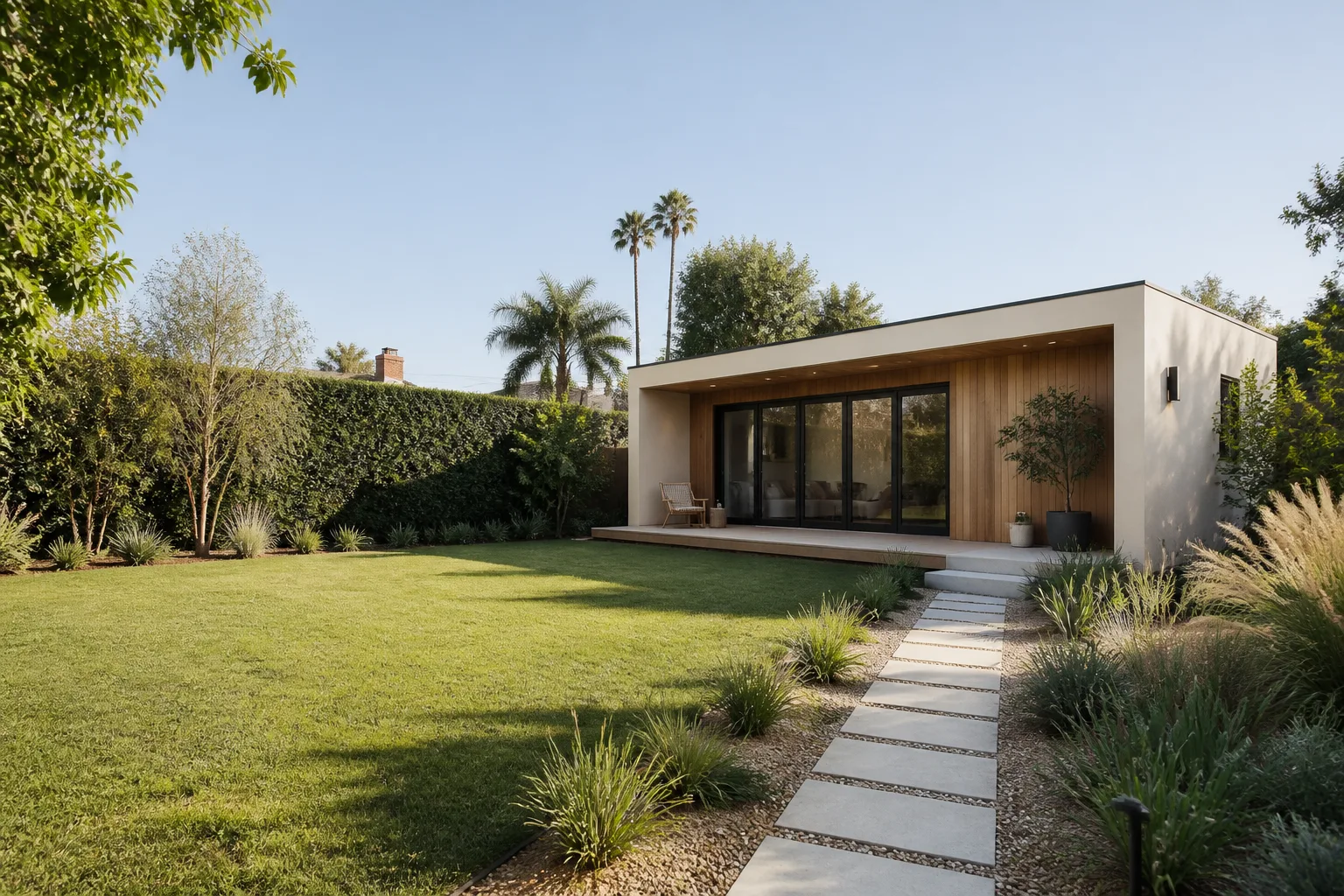
The prefab option has changed the local landscape, too. ADU Builders in Fresno now regularly work with brands like Abodu and Cover, which ship factory-built units that get craned onto a slab in a day. The appeal is obvious: a controlled factory environment means no weather delays, no lumber sitting in the rain. But the site work still happens in Fresno, and the foundation, utility trenching, and finish work are where quality varies. Prefab doesn’t remove the contractor from the equation. It changes what the contractor does.
Step 1: Verify the Fresno Contractor’s CSLB License
Before you ask a contractor anything, you check the license. This takes four minutes and eliminates most of the nightmare scenarios in one step. The Contractors State License Board maintains a searchable database at cslb.ca.gov. Enter the contractor’s name or license number. Look for three things: the license is active, the classification matches the work (we’ll cover this in Step 2), and the bond is current.
Here’s the exact sequence:
- Go to cslb.ca.gov and click “Check a License.”
- Enter the license number from the contractor’s business card or website. If the contractor has no license number displayed, that’s your first red flag. Licensed contractors in California are required to show the number on all advertising, including business cards and websites.
- Confirm the status reads “Active” and not “Suspended” or “Expired.” A suspended license often means an unpaid judgment or a failed worker’s comp audit.
- Check the “Workers’ Comp” field. If it says “No employees,” the contractor is a sole operator. That’s not disqualifying for a small ADU, but it means any helper on your property is either a subcontractor with their own coverage or potentially uninsured. If the contractor has employees, the workers’ comp policy should be active.
- Look at the license issue date. Ten years of active, clean licensing is a stronger signal than a license issued eight months ago. AB 68 made ADUs attractive to new entrants, and not all of them belong in your backyard.
In Fresno specifically, we’ve seen homeowners skip this step because the contractor was recommended by a neighbor. A referral is useful, but it doesn’t replace the CSLB check. The neighbor’s job may have gone fine while the contractor’s license was suspended over a dispute on a different project.
Step 2: Understand What the License Classifications Actually Mean
The CSLB issues licenses by classification, and the letter before the number tells you what the contractor is legally allowed to build. For an ADU in Fresno, the relevant classifications are:
- Class B – General Building Contractor: Licensed to build, alter, and repair structures. A B license can manage the entire ADU project, including framing, roofing, plumbing, and electrical, as long as they use licensed subcontractors for the specialty trades. This is the classification most ADU companies carry.
- Class A – General Engineering Contractor: Licensed for heavy work like foundations, grading, and utility connections. An A is not enough to build an ADU by itself, but it’s common for site preparation specialists.
- C-5 – Framing and Rough Carpentry: Framing only. A C-5 contractor cannot build your ADU alone.
- C-6 – Cabinet, Millwork, and Finish Carpentry: Finish work only.
- C-8 – Concrete: Foundations and slabs only.
- C-36 – Plumbing: Water and drain lines only.
- C-10 – Electrical: Wiring, panels, and service connections only.
What does this mean for you? A contractor holding only a C-36 plumbing license cannot legally build your entire ADU. A contractor holding a B license is qualified to manage the whole project. Most home addition contractors in Fresno who build ADUs carry a B classification. When you check the license in Step 1, note the classification and make sure it matches the scope. A mismatch is a CSLB violation, and more practically, it’s a sign the contractor is operating outside their lane.
Step 3: The Five Interview Questions That Expose Scope-Creep Risk
You’ve verified the license. Now you’re sitting across from the contractor at your kitchen table. The following five questions are the filter. Most homeowners ask about timeline and cost. Those questions come later. These five come first, and they reveal how the contractor handles ambiguity, which is where ADU costs spiral.
Question 1: “Walk me through what happens when we open the walls and find something unexpected.”
Every ADU project encounters surprises. In Fresno’s older neighborhoods like Tower District and the Fig Garden area, we routinely find unpermitted additions, outdated wiring, or dry rot in the sill plates. The right answer sounds like this: “We photograph it, we stop work on that section, we bring you a written change order with a price, and we don’t resume until you sign it.” The wrong answer sounds like this: “We’ll figure it out as we go” or “Trust me, we’ll take care of it.” A contractor who can’t describe the change order process before work starts will not suddenly develop one when the surprise costs $9,000.
Question 2: “Who will be on site every day, and how do I reach them?”
You deserve to know who is walking on your property. The right answer includes a named person, a phone number, and a defined arrival window. The wrong answer is “one of my guys.” In the Kingswell family of home-service companies, the standard has always been background-checked, uniformed technicians with a live person answering calls. If the contractor can’t tell you who is on site, they don’t have the operation to manage your build.
Question 3: “What is the payment schedule, and what triggers each payment?”
The correct answer ties payments to completed milestones, not calendar dates. A legitimate schedule might be: 10% at contract signing, 25% after foundation, 25% after framing and rough-in, 25% after drywall and finishes, 15% after final inspection and walkthrough. A red flag answer ties a large payment to “mobilization” or asks for 50% up front. In California, a home improvement contractor cannot legally ask for more than 10% or $1,000, whichever is less, as a down payment. Any contractor asking for more is violating state law, period.
Question 4: “What happens if your crew damages my property?”
A real contractor answers immediately: “We are insured, we will file a claim, and we will fix it.” A hesitant answer or a vague “we’ll take care of it” without specifics is a problem. Ask to see the certificate of insurance. Call the insurer and confirm the policy is active. It takes ten minutes. In Fresno, we’ve seen homeowners absorb the cost of a damaged fence or broken sprinkler line because they never confirmed coverage. The certificate you’re holding should name the insurance company and the coverage amounts for general liability. It should not be a handwritten note.
Question 5: “Can you put everything you just said in writing?”
This is the one that ends conversations with the wrong contractor. If the answer to any of the first four questions was good, you need it in writing. The contractor who hesitates, says “we don’t do that,” or acts offended is telling you their promises are only as good as their memory. The Lodgewick ADU Fresno home approach has always been to write everything down before work starts: the price, the arrival window, the cleanup standard, and the guarantee. The Kingswell Guarantee is not a handshake. It’s a document. If a contractor won’t put a promise in writing, that promise doesn’t exist.
Step 4: How to Read a Written Price Line by Line
A legitimate written price looks like a spreadsheet, not a memo. The difference matters. Vague line items are where costs explode later. Here’s what to look for when you read a Fresno ADU bid:
- Site preparation and demolition: This should name what is being demolished and what is being protected. If it just says “demo as needed,” that’s an open door. As needed is where the $4,000 change order lives.
- Foundation: Specify the type: slab on grade, raised, or pier. In Fresno’s soil, slab on grade is standard, but the line item should say so.
- Framing: Should name the lumber type (typically Douglas fir or SPF) and the spacing. If it says “framing per plan,” ask what plan. The plan should exist before the price does.
- Rough plumbing: Should include fixture counts. “Two sinks, one toilet, one shower” is a line item. “Plumbing as needed” is a blank check.
- Rough electrical: Should include the panel upgrade. An ADU almost always requires a new subpanel or an upgrade to the main panel. If the electrical line doesn’t mention a panel, ask where it is hidden.
- Insulation and drywall: In Fresno, this should name the R-value. R-13 walls and R-38 attic are typical for new ADUs. If the bid says “standard insulation,” you need the number.
- Finishes: Flooring, cabinets, countertops, and fixtures should be itemized with allowances. A $5,000 cabinet allowance means the contractor will build with materials up to that amount, and you’ll pay the difference for anything over. Know your allowances.
- Permits and inspections: This should be a line item with the actual Fresno permit fees. The city’s fee schedule is public. A contractor padding this line by several thousand dollars is either dishonest or estimating for trouble.
When a bid has one line that says “ADU construction: $210,000,” you are not reading a price. You are reading a guess. The contractors who produce real written prices are the ones who already built the project on paper. The ones who produce lump sums are the ones who will build it on your credit card.
Step 5: Why the Cheapest Bid in Fresno Is Usually the Most Expensive
The cheapest bid in Fresno is structurally likely to be the most expensive because it omits what the contractor plans to charge for later. This is not speculation. It’s arithmetic. Here’s the example we use with homeowners:
Homeowner receives three bids on a 600-square-foot attached ADU in the Tower District. Bid A is $195,000. Bid B is $215,000. Bid C is $168,000. Homeowner hires Bid C. Four months into the project, the change orders start arriving. The electrical panel the bid didn’t mention: $4,800. The kitchen exhaust that was missing from the rough-in: $1,900. The dry rot discovered behind the old stucco: $3,200. The “site cleanup” the original scope excluded: $1,500. Total: $11,400 in changes, bringing the final cost to $179,400. Still under Bid B, but now the homeowner has spent four months negotiating change orders instead of living in the finished ADU. The real cost of the cheapest bid was not just $11,400 in change orders. It was the lost rental income, the lost time, and the stress of a project that never had a fixed number.
We’ve seen this pattern repeat across Fresno, from Mural District to Woodward Park. The cheapest bid is often a marketing number, not a construction number. It gets the signature, and then the real price arrives in phases. The contractors who produce line-item written prices are not guessing. They have done the takeoff. Their numbers are higher because they are honest about what the project actually includes. That’s not a premium. That’s the price of the finished ADU.
Step 6: How to Read a Subcontractor List Without Being a Detective
Most ADU problems originate with subcontractors the homeowner never met. This is the hidden variable in every bid. The general contractor you hire is a manager, and the workers who frame, plumb, and wire your ADU are often not the company’s own employees. In Fresno, the subcontractor pool is tight. Good electricians and plumbers are booked months out. The cheapest general contractors often use the cheapest subs, because the margin isn’t there to hire better crews.
Ask for the subcontractor list before you sign. A legitimate response names the companies: “We use Central Valley Electric for the wiring and Fresno Plumbing & Rooter for the rough-in.” A red-flag response is “we have guys we work with.” If the contractor won’t name the subcontractors, you cannot check their licenses. And if the subcontractor is unlicensed or underinsured, and something goes wrong, the liability lands on you. Property damage caused by an unlicensed sub on your project can become your insurance claim, your deductible, and your problem.
Here’s the four-part check for every subcontractor on the list:
- Verify the sub’s license is active on cslb.ca.gov.
- Confirm the classification matches the trade: C-10 for electrical, C-36 for plumbing, C-8 for concrete.
- Ask whether the sub carries their own liability insurance or is covered under the general contractor’s policy. If the GC says “don’t worry about it,” worry about it.
- Ask whether the same sub crew has been used on their last three projects. Consistency matters. A sub who has worked with the GC for years is a known quantity. A sub hired at the lowest bid is an experiment.
At Lodgewick ADU Fresno, we work with subcontractors we know by name and by track record. The garage conversion contractors in Fresno who consistently deliver clean jobs use the same crews project after project. A rotating cast of unfamiliar subs is a sign the GC is buying labor on price, not on quality.
Step 7: The Final Check Before You Sign
You’ve verified the license, asked the five questions, read the written price line by line, and reviewed the subcontractor list. Before you sign, run this final sequence:
- Confirm the contract includes the written price you reviewed. If the price in the contract is a lump sum different from the line items, stop. The contract price should match the written estimate to the dollar.
- Confirm the change order process is in the contract. The contract should state that no work outside the original scope begins without a written change order signed by you. If it’s not in the contract, it doesn’t exist.
- Confirm the guarantee is in the contract. Ask what happens if the work fails within the first year. If the answer is “we’ll fix it,” ask for that in writing. The Kingswell Guarantee, for reference, is a written document presented before any work begins, not a promise made after the check clears.
- Confirm the permit plan. In Fresno, ADU permits go through the city, and the contractor should pull them. If the contractor suggests you pull the permit in your own name to “save money,” that’s a red flag. The contractor who pulls the permit is the contractor responsible for the inspection passing.
- Confirm the payment schedule matches Section 3, Question 3. No more than 10% down, with subsequent payments tied to completed milestones.
- Read the contract cover to cover. If it’s three pages of dense legal text and you don’t understand a clause, ask. A real contractor will explain it in plain English. A contractor who says “it’s standard” without explaining is not answering the question.
The signature is not the starting line. It’s the finish line of the hiring process. Every step before it is the work. The homeowners who get burned are the ones who treat the contract as a formality. The homeowners who build successfully are the ones who treated hiring as a job with phases: verify, ask, read, confirm, then sign.
Common Mistakes to Avoid
- Skipping the CSLB check because a neighbor referred the contractor. A referral is a starting point, not a license check. Ten minutes on cslb.ca.gov protects you from a problem your neighbor didn’t see. Check it every time.
- Signing a contract with a lump sum instead of line items. A single number with no breakdown is a blank check. The line items are where you catch the missing panel and the missing plumbing fixture before they become change orders.
- Believing the cheapest bid is a deal. In Fresno’s ADU market, the cheapest bid is usually the contractor who is either missing scope or planning to find it later. The change orders on a cheap bid routinely exceed the gap between the cheap bid and the honest bid.
- Paying more than 10% down. California law caps the down payment for home improvement work at 10% or $1,000, whichever is less. A contractor asking for more is breaking state law. Full stop.
- Not asking who will be on site each day. You have a right to know who is walking your property. A contractor who can’t name the crew lead doesn’t have the operational control to run your build.
- Treating the guarantee as a verbal promise. A guarantee that isn’t in writing does not exist. Get it in the contract, name the duration, and know what happens if the work fails. The 365-Day Done Right Promise exists because verbal guarantees have a way of expiring the moment the final check clears.
- Hiring a contractor who won’t pull permits. Unpermitted ADUs in Fresno create problems at resale, with your insurance, and with the city. The contractor who suggests skipping permits is asking you to absorb that risk. The permit is not the enemy. It’s your protection.
When to Call a Professional
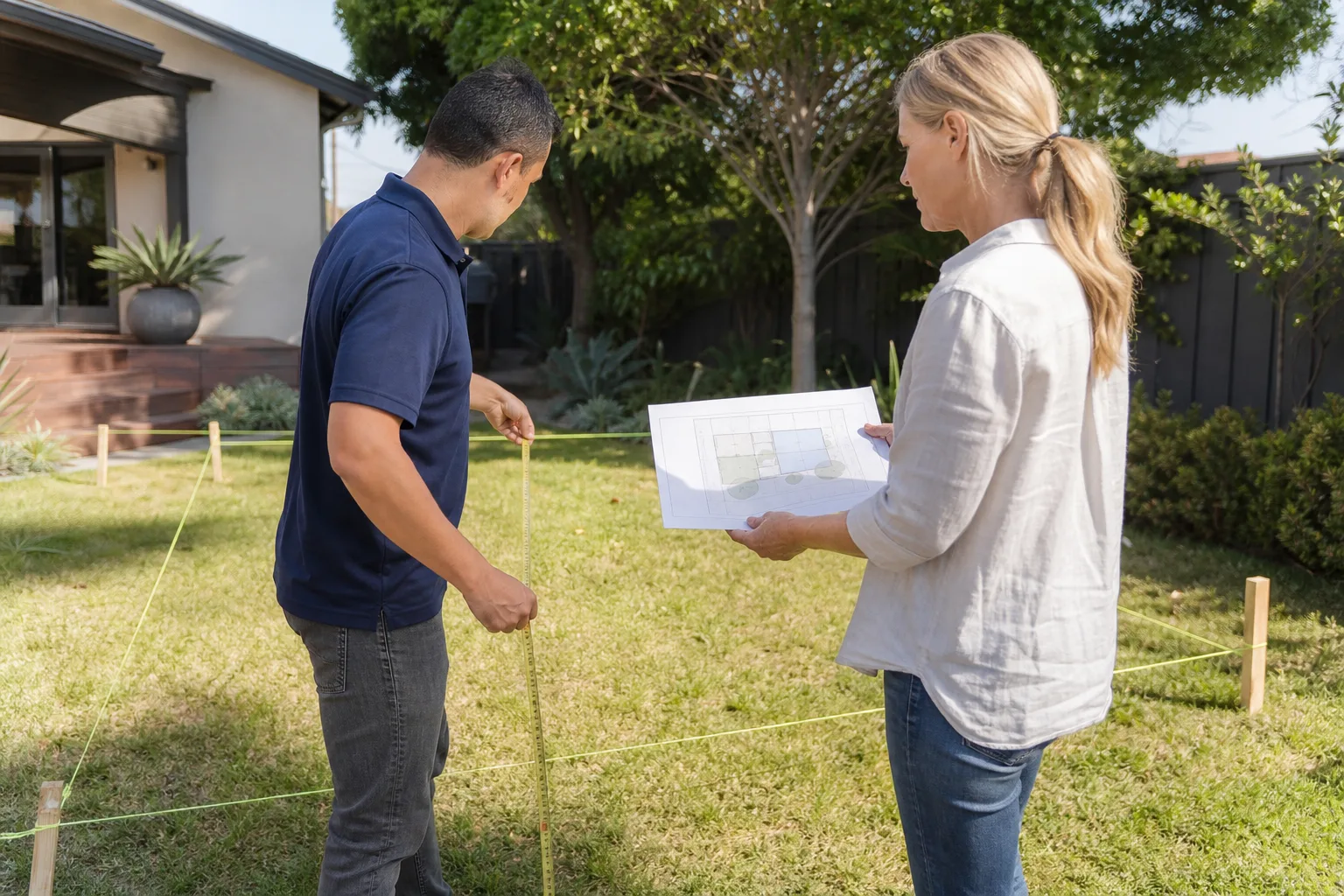
If you’re still reading, you’re likely in one of two positions: you’re about to start the hiring process, or you’re already in the middle of it and something doesn’t feel right. Both positions benefit from a second set of eyes. If a contractor’s written price feels vague, if you found a licensed sub who shouldn’t be on the list, or if you just want someone to walk your lot and give you an honest read on what your ADU will cost, call. Lodgewick ADU Fresno offers free estimates in Fresno. Call (559) 354-0579, and a live person will answer. We’ll walk the property, talk through your options including the prefab brands like Tuff Shed and Abodu, and give you a written price with line items you can hold in your hand. No pressure, no change orders at the door. That’s the Kingswell Way.
Frequently Asked Questions
Attached ADUs in Fresno typically run $280 to $360 per square foot for site-built construction, while detached ADUs land between $320 and $400 per square foot depending on site conditions and finishes. A 600-square-foot attached ADU generally costs $170,000 to $215,000, and a 600-square-foot detached unit runs $190,000 to $240,000. Garage conversions are usually on the lower end because the shell already exists. Prefab units from companies like Abodu and Cover can be comparable when you factor in site work, utilities, and finishes. Call (559) 354-0579 for a written line-item estimate on your specific property.
Yes, every ADU in Fresno requires a building permit, and most require electrical, plumbing, and mechanical permits as well. The contractor should pull the permits and schedule inspections with the city. Unpermitted ADUs create problems at resale, with your homeowner’s insurance, and potentially with the city if a complaint is filed.
A site-built ADU in Fresno typically takes six to ten months from permit approval to final inspection, depending on the size, site conditions, and weather. Garage conversions run faster, usually four to seven months. Prefab units can shorten the on-site construction phase significantly, but site work, foundation, utilities, and finishes still add two to four months.
Most single-family lots in Fresno can accommodate an ADU under current state law and local zoning, but lot coverage, setback, and utility requirements vary by property. A site visit from a licensed contractor can tell you quickly whether your specific lot has constraints. Lodgewick ADU Fresno offers free site assessments call (559) 354-0579 to schedule one.
A JADU, or junior accessory dwelling unit, is a smaller unit created within the existing footprint of the primary house, typically under 500 square feet, with its own entrance and efficiency kitchen. An ADU, or accessory dwelling unit, is a self-contained living space with a full kitchen and bathroom, either attached to the house, detached in the yard, or converted from a garage. JADUs are faster and cheaper, but ADUs offer more space and rental value.
No, you don’t need to be home during construction, but you should have a clear line of communication with the contractor. The contractor should provide a defined arrival window and a live point of contact for questions. At Lodgewick ADU Fresno, a live person answers calls 24/7, and background-checked, uniformed technicians work on site so you always know who is on your property, whether you’re home or not.
The Bottom Line
Hiring an ADU contractor in Fresno is a filtering process, not a bidding contest. The filter is five questions, a license check, a line-item price, and a subcontractor list you actually read. The homeowners who get burned skip the filter and chase the number. The homeowners who build successfully treat hiring as a job with phases, and they take each phase seriously. Fresno’s heat, soil, and permitting process are known quantities. Every variable in an ADU project is manageable when the price is written, the guarantee is in the contract, and the person on site is someone you can name. If you don’t have those three things yet, keep looking.
Call (559) 354-0579 to schedule your free estimate with Lodgewick ADU Fresno. We’ll walk your lot, give you a written price, and put the guarantee in writing before a single nail is driven.
Written by Russ Delmar, Owner at Lodgewick ADU Fresno, serving Fresno since 2010.