Last updated October 15, 2026
The Complete Guide to ADU in Fresno
Most Fresno homeowners walk into their ADU project carrying a California guide written for coastal lots around 6,000 square feet. The average Fresno lot is closer to 7,200 square feet, and that extra 1,200 square feet changes setbacks, unit size limits, and what you can actually build. This guide-along with more guides & resources on our blog-lays out how accessory dwelling units (ADUs), the secondary small homes you can build on your existing property, work under Fresno’s specific rules, climate, and utility infrastructure. You’ll learn what your lot actually allows, what it costs in this market, which neighborhoods are approving ADUs fastest, and where to start.
Quick Answer
A detached ADU in Fresno typically costs between $180,000 and $350,000 depending on size, foundation type, and whether you choose a site-built or prefab route, while garage conversions run $90,000 to $180,000. Fresno allows ADUs up to 1,000 square feet on most single-family lots, with 4-foot rear and side setbacks, though your specific lot size and zoning district may tighten or loosen these numbers. The fastest approvals in Fresno are currently happening in Sunnyside, Tower District, and the areas around Fresno State, where 60 to 90 day review timelines are common for straightforward detached ADUs.
Table of Contents
- Fresno Lot Rules: Why 7,200 Square Feet Changes Everything
- What an ADU Actually Costs in Fresno Right Now
- PG&E and Utility Connections: The Hidden Timeline and Cost
- Which Fresno Neighborhoods Are Approving ADUs Fastest
- How Fresno Heat Shapes Your ADU Design and Schedule
- Detached, Attached, JADU, or Garage Conversion: Choosing Your Path
- Prefab vs Site-Built in Fresno: What the Brands Actually Deliver
- The Fresno ADU Permit Process, Step by Step
- Common Mistakes to Avoid
- When to Call a Professional
- Frequently Asked Questions
- The Bottom Line
Fresno Lot Rules: Why 7,200 Square Feet Changes Everything
State law sets ADU minimums that every California city must allow, but Fresno’s zoning code layers its own requirements on top. The state says cities must permit 800-square-foot detached ADUs with 4-foot rear and side setbacks regardless of lot size. Fresno follows these minimums, but the city’s lot coverage rules interact with your property size in ways that matter.
A 6,000-square-foot coastal lot with a 1,800-square-foot house and a detached garage sits around 45% lot coverage, leaving room for a 1,000-square-foot ADU before hitting Fresno’s 50% maximum lot coverage for combined structures in most single-family residential zones. A Fresno lot at 7,200 square feet with a 1,600-square-foot ranch-style home, common in neighborhoods like Sunnyside and West Fresno, sits at 22% coverage before you build anything. That leaves 2,000 square feet or more of buildable coverage room, which means your ADU size is governed by the state’s 1,000-square-foot maximum, not by lot coverage limits. This is why Fresno homeowners often have more flexibility than they expect.
Where Fresno does tighten the screws: the city requires that detached ADUs match the architectural character of the primary dwelling in designated historic districts, which covers parts of the Tower District. If your home has a distinct historical facade, the city’s planning department will ask your ADU to use compatible roof pitch, siding material, and window proportions. This adds design review time, roughly two to four weeks, and sometimes adds $5,000 to $15,000 in architectural fees for drawings that satisfy the review board.
Fresno also maintains an 850-square-foot maximum for attached ADUs and a 1,200-square-foot cap for detached conversions of existing structures like workshops or pool houses that exceed the standard 1,000-square-foot limit. A garage conversion, where you convert an existing attached or detached garage into living space, has no size cap beyond the existing structure footprint and the state’s 1,200-square-foot conversion allowance.
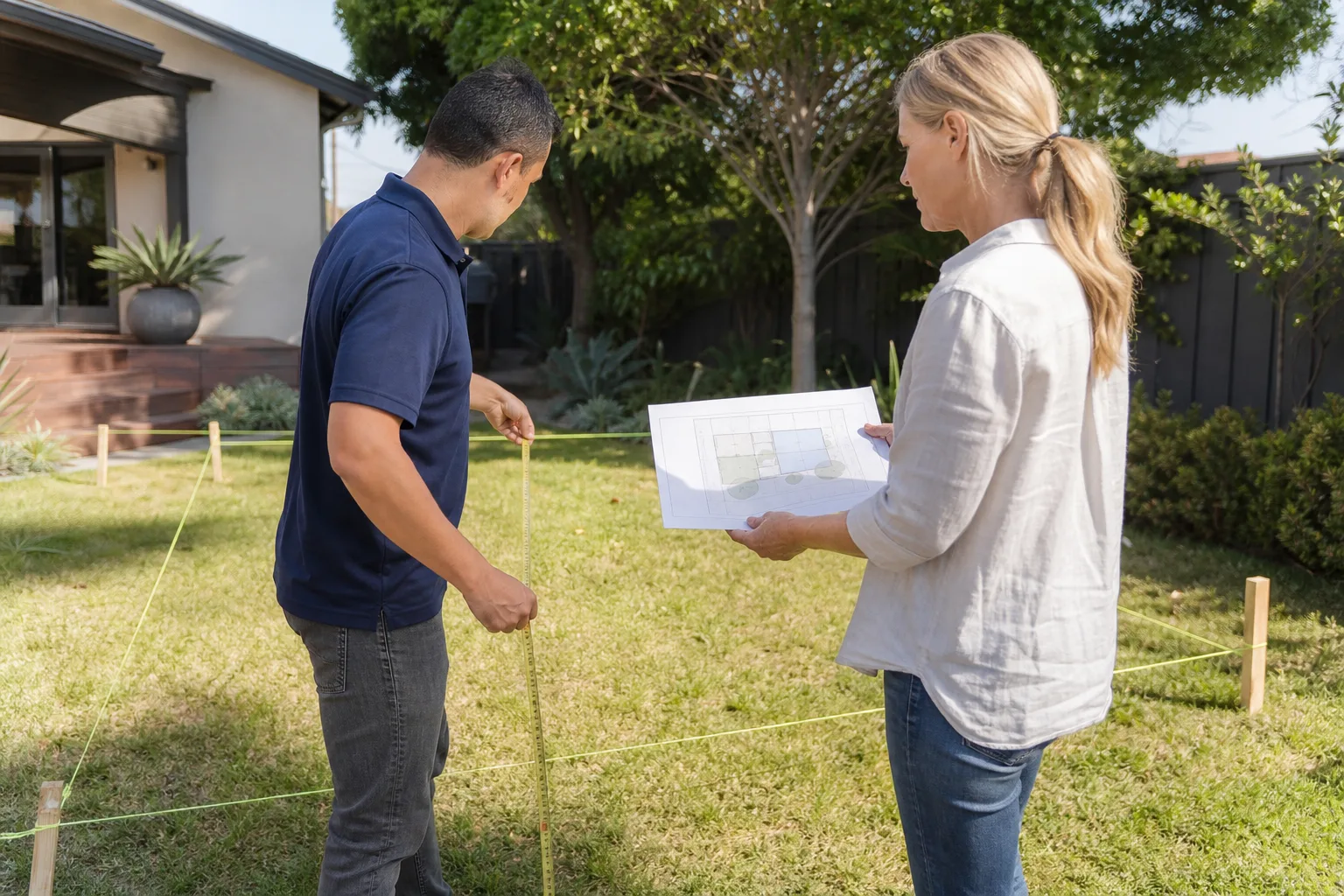
If you’re looking for a ADU Builders in Fresno team that works through these calculations with you before you spend money on drawings, start with a site assessment. A site assessment maps your lot lines, existing structures, utility locations, and setback envelopes so you know what you can build before you fall in love with a plan the city will reject.
Fresno Lot Size Scenarios
- 6,000 sq ft lot, 1,800 sq ft home, attached garage: Detached ADU up to 800 sq ft with 4-ft setbacks. Lot coverage typically not a constraint.
- 7,200 sq ft lot, 1,600 sq ft home, no garage: Detached ADU up to 1,000 sq ft. Setbacks and utility access are your only real constraints.
- 8,500 sq ft lot, 2,200 sq ft home, detached garage: Detached ADU up to 1,000 sq ft plus possible garage conversion of 400 sq ft. Larger corner lots may allow 1,200 sq ft.
- 5,000 sq ft lot, 1,400 sq ft home, attached garage: Detached ADU up to 800 sq ft. Lot coverage becomes a factor; garage conversion is usually the better path.
What an ADU Actually Costs in Fresno Right Now
National ADU cost estimates put the average at $150 to $300 per square foot, but Fresno’s labor and material market in 2025-2026 runs lower than coastal California and higher than national averages. Expect $180 to $350 per square foot for a site-built detached ADU, which breaks down to $180,000 to $350,000 for a 1,000-square-foot unit. Garage conversions run $90,000 to $180,000 for a typical 400 to 500 square foot conversion, or roughly $180 to $280 per square foot.
Here’s the line-item breakdown that online calculators leave out:
- Design and permit drawings: $8,000 to $18,000 for architectural and structural plans, title 24 energy calculations, and permit submission.
- Site prep and foundation: $15,000 to $35,000 depending on soil conditions. Fresno’s expansive clay soils in the eastern neighborhoods sometimes require deeper footings or soil treatment, which pushes this higher.
- Framing and shell: $45,000 to $80,000 for a 1,000-square-foot unit. Lumber prices have stabilized, but Fresno’s summer heat means framing crews start at 5:30 a.m. and knock off by 1:00 p.m., which stretches the framing timeline.
- Plumbing, electrical, HVAC: $25,000 to $50,000. A minisplit heat pump system for Fresno’s 100-degree summers runs $8,000 to $14,000 installed.
- Insulation and drywall: $12,000 to $22,000. Fresno’s Title 24 climate zone 13 requirements mean R-38 ceiling insulation and R-21 wall insulation are standard.
- Finishes (flooring, cabinetry, paint, fixtures): $25,000 to $60,000 depending on your choices.
- Utility connections (PG&E, water, sewer): $10,000 to $35,000. More on this below, because this is the number most homeowners never see coming.
For a clearer picture of what full additions run, visit our Home Addition Contractor in Fresno page. But the short version: a garage conversion is the cheapest entry point, a site-built detached ADU gives you the most square footage flexibility, and a prefab unit sits in between depending on the brand.
PG&E and Utility Connections: The Hidden Timeline and Cost
Every statewide ADU guide skips this. In Fresno, PG&E service upgrades and new meter installations are running 12 to 20 weeks from application to completion for a standard 125-to-200-amp upgrade, and 8 to 14 weeks for a subpanel feed from an existing service. If your existing panel is 100 amps and your ADU needs its own 60-amp service, you’re looking at an upgrade. If your panel is 200 amps with capacity to spare, a subpanel tap is your fastest and cheapest route.
Typical PG&E-related costs in Fresno:
- Service upgrade from 100 to 200 amps: $4,000 to $8,000 including the electrician’s labor, new panel, and PG&E fees.
- Subpanel tap from existing 200-amp service: $1,500 to $3,000.
- Trenching for new gas or electric line from the street or main service: $2,500 to $7,000 depending on distance and whether you trench through concrete.
- New water meter and sewer lateral connection: $5,000 to $12,000 for a detached ADU. Fresno’s Department of Public Utilities requires separate water and sewer laterals for detached units in most cases; attached ADUs and conversions can often share the primary dwelling’s laterals.
The sequencing matters. You should apply for your PG&E service upgrade the same week you submit your building permit to the City of Fresno. PG&E’s timeline runs in parallel with the city’s plan review, not after it. Homeowners who wait until their building permit is approved discover a 12-to-20-week utility delay stacked on top of their 8-to-12-week plan review. Those who apply concurrently finish their entire utility connection before the first framing nail is driven.
Which Fresno Neighborhoods Are Approving ADUs Fastest
ADU permit volume in Fresno has grown steadily since the state’s 2020 ADU reforms took full effect, but the pace of approval varies neighborhood by neighborhood. Sunnyside, Tower District, and the neighborhoods surrounding Fresno State consistently see the most ADU permits and the quickest review timelines for three reasons: they have the highest concentration of larger lots, the neighborhoods are zoned for single-family residential with no historic or design overlay restrictions, and the city’s planning staff has processed enough applications in these areas that the review path is well-worn.
Sunnyside, bounded roughly by Kings Canyon Road, Clovis Avenue, and Peach Avenue, has 7,000 to 9,000-square-foot lots as a norm. A 1,000-square-foot detached ADU fits these lots without variance requests, which is the single biggest source of delay anywhere in California. Tower District is trickier because of its historic designation, but attached ADUs and garage conversions within the existing building envelope move faster than new detached construction.
What this means for your timeline: a straightforward detached ADU on a standard Sunnyside lot can clear plan review in 60 to 90 days. The same project on a lot in a historic or design overlay district, or on a lot under 5,000 square feet, can take 120 to 180 days. Knowing your neighborhood’s plan-check history before you buy plans is leverage.
If you want a local team that knows the plan check patterns in your specific Fresno neighborhood, start with the Lodgewick ADU Fresno home page, where you can schedule a site assessment and get a written price before any work begins.
How Fresno Heat Shapes Your ADU Design and Schedule
Fresno averages 110 days per year above 90 degrees and 36 days above 100. That heat changes three things about your ADU: when it can be built, what it’s built from, and what it costs to keep cool.
First, scheduling. Roofing, exterior paint, stucco, and concrete pours in Fresno follow the heat. Concrete pours happen before 10 a.m. from June through September. Roofers work from dawn to noon and down tools when roof surface temperatures pass 120 degrees. This isn’t a scheduling failure; it’s a reality of building in the Central Valley. A project that starts in April moves faster than one that starts in July because exterior trade work compresses into shorter weather windows. Plan for a 4-to-6-month build on a site-built ADU starting in spring, versus 6-to-8 months for a summer start.
Second, materials. Fresno’s Title 24 energy code (climate zone 13) requires more insulation than the state minimum in cooler coastal zones. Your ADU should be designed with R-38 ceiling insulation, R-21 walls, low-E glazing on all windows, and a minisplit heat pump sized for 100-degree design temperatures. Cheap vinyl windows and minimal insulation that pass code in San Diego fail comfort standards in Fresno by July.
Third, roof color. This is the detail that cuts your cooling bill by 10 to 15 percent in Fresno: a cool roof. Title 24 requires cool roofs for many new residential structures in climate zone 13, but if you’re converting a garage or adding a flat-roof ADU, you choose whether to install a cool-rated membrane. Given that your ADU’s roof will absorb 100-plus-degree sun for a third of the year, install the cool roof. The incremental cost is $1,500 to $4,000, and the annual cooling savings on a 1,000-square-foot unit run $300 to $600.
Detached, Attached, JADU, or Garage Conversion: Choosing Your Path
Fresno allows every ADU type the state permits, and each one fits a different homeowner profile.
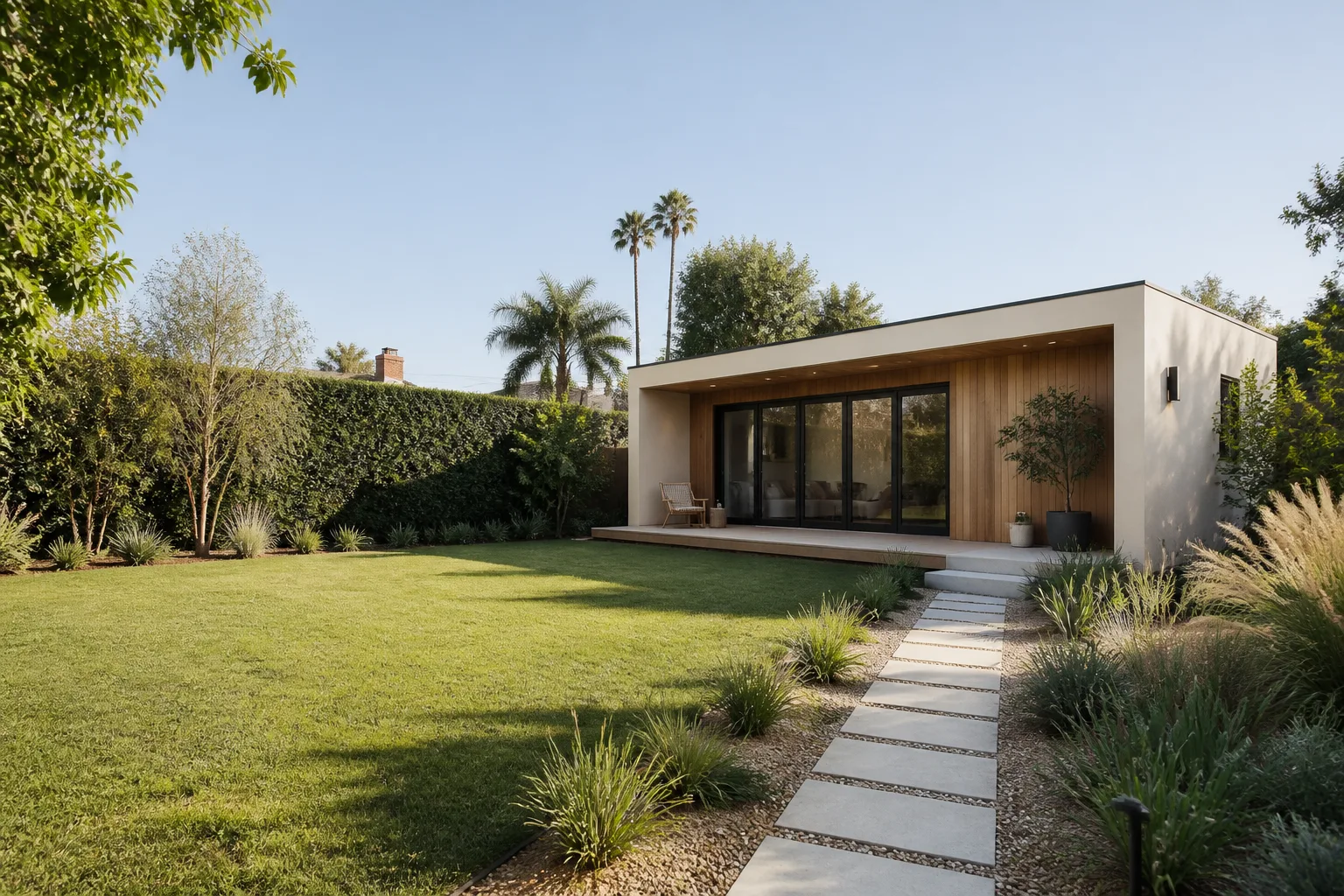
- Detached ADU. A standalone structure in your backyard, up to 1,000 square feet (or 1,200 if converted from an existing structure like a workshop). Highest cost, highest rental income, most privacy for tenants. Best for lots over 7,000 square feet.
- Attached ADU. An addition that shares a wall with your home, up to 850 square feet in Fresno. Lower cost than detached due to shared walls and simpler utility runs. Good for aging parents or adult children who need proximity with some separation.
- JADU (Junior ADU). A 500-square-foot maximum unit created within the walls of your existing home, often a converted bedroom with a kitchenette and separate entrance. Lowest cost, typically $50,000 to $90,000 in Fresno. No separate utility connections required. Best for homeowners who want a rental unit inside their own house.
- Garage conversion. Converting an existing attached or detached garage into a living unit. No size cap beyond the existing footprint. Cost runs $180 to $280 per square foot. Fastest path to a rentable unit because foundation, roof, and framing already exist. For a deeper dive, see our Garage Conversion Contractor in Fresno page.
Choose based on three questions: What fits your lot? What fits your budget? What does your household actually need in five years? A garage conversion that houses your mother-in-law today becomes a rental unit when she moves out. A detached ADU is the most flexible long-term asset.
Prefab vs Site-Built in Fresno: What the Brands Actually Deliver
Fresno homeowners increasingly ask about prefab ADUs, the factory-built units that arrive on a truck and are craned into place. The appeal is speed and price certainty. The reality is more nuanced in Fresno than in the Bay Area or Los Angeles.
Abodu and Dvele are the two brands we see most often in Fresno inquiries. Abodu delivers a 500 to 1,000 square foot unit that is set on a site-built foundation; their units are popular for their speed, with delivery in 4 to 7 months after permitting, and their fixed price point, which currently runs $200,000 to $400,000 delivered and installed for their standard models. Dvele builds higher-end units with integrated smart-home systems and stronger energy performance; their pricing starts around $350,000 and runs well past $600,000 for their larger configurations. Mighty Buildings offers 3D-printed wall panels that arrive as a kit and are assembled on site in Fresno; their pricing lands between Abodu and Dvele for comparable square footage.
Here’s what no brand brochure tells you: a prefab unit still needs the same site preparation, foundation, PG&E connection, water and sewer laterals, and city permits as a site-built ADU. The prefab saves you framing time and framing labor, but not utility timelines or permit timelines. In Fresno, the permitting path for a prefab unit goes through the same city plan check as a site-built structure, plus a state factory inspection certificate that the city and county require.
The honest comparison: prefab delivers more price certainty and a shorter on-site construction window, roughly 3 to 5 months versus 5 to 8 months for site-built. Site-built delivers more design flexibility for Fresno’s unique lot shapes, and on a square-footage basis, site-built typically runs $20 to $50 less per square foot for comparable finish quality. The right answer depends on your timeline and how much design flexibility you need.
We work with the prefab brands that deliver to Fresno and handle the site prep, foundation, utilities, and finishing so the factory unit is one part of a complete project under our written ADU build guarantee.
The Fresno ADU Permit Process, Step by Step
Here’s the actual sequence, not the glossy version:
- Site assessment and feasibility check. Before any money changes hands for design, map your lot boundaries, setbacks, existing structures, utility locations, and zoning constraints. This step costs $500 to $1,500 and prevents $8,000 in wasted design fees for a plan the city rejects. A qualified ADU builder does this during the estimate phase.
- Design and Title 24 energy calculations. Your architect or design-build firm produces construction drawings plus the energy compliance documentation. Budget 3 to 6 weeks and $8,000 to $18,000. In historic overlay zones, expect additional facade and materials documentation for design review.
- Building permit submission to the City of Fresno. Submit through the Planning and Development Department’s ADU review track. Straightforward detached ADUs on standard lots clear plan review in 60 to 90 days. Projects on constrained lots or in historic zones run 120 to 180 days.
- Concurrent PG&E and utility applications. Submit your PG&E service request the same week as your building permit. Apply for water and sewer lateral connections with the Fresno Department of Public Utilities at the same time. This parallel path saves 2 to 4 months on your overall timeline.
- Permit issuance and construction. Once the city approves plans and fees are paid, your permit is issued. Construction begins. Site-built detached ADUs run 5 to 8 months in Fresno depending on start season. Garage conversions run 3 to 5 months. Prefab units run 3 to 5 months on-site after the foundation is ready.
- Inspection milestones. Foundation, framing, rough plumbing/electrical/mechanical, insulation, drywall, and final. The City of Fresno inspects each phase before the next can proceed. Budget 2 to 4 weeks of total inspection time, more during summer when inspector availability tightens.
- Utility activation and certificate of occupancy. PG&E energizes your service. The city issues a certificate of occupancy after final inspection and utility sign-offs. You can now legally rent or occupy your ADU.
Common Mistakes to Avoid
- Applying for the PG&E upgrade after the building permit is approved. This sequencing error adds 12 to 20 weeks to your project. Apply the same week as your building permit and run the two paths in parallel.
- Designing an ADU for another city’s climate. Plans purchased online or designed for coastal conditions often under-spec insulation and glazing for Fresno’s 100-degree summers. Use Title 24 climate zone 13 standards or you’ll pay double in cooling bills for the life of the unit.
- Ignoring lot coverage limits on smaller Fresno lots. State minimums don’t override Fresno’s 50% lot coverage rule in many zones. If your house already covers 42% of your lot, your ADU size is constrained more by coverage math than by the state’s square footage maximum.
- Skipping the site assessment to save $1,000. The assessment is the cheapest insurance against an $8,000 set of drawings for a project the city rejects at plan check.
- Choosing the cheapest foundation bid on expansive clay soil. East Fresno neighborhoods with expansive clay soils require deeper footings or soil treatment. A foundation that fails inspection means demolition and re-pour, a $20,000 to $40,000 mistake.
- Assuming a prefab ADU skips the utility and permit timeline. Prefab saves framing time, not permit or utility time. Budget for the same 60-to-90-day plan review and 12-to-20-week PG&E timeline regardless of construction method.
- Signing a contract without a written price and scope. If a builder won’t put the price in writing before work begins, that’s the end of the conversation. Every reputable Fresno ADU builder works from written fixed pricing, never cost-plus or open-ended scope.
When to Call a Professional
Call an ADU builder before you spend money on design, not after. If you’re unsure whether your lot can accommodate a detached unit under Fresno’s setbacks and coverage rules, a site assessment answers that in one visit. If your panel is 100 amps and you don’t know what a service upgrade costs, an electrician’s walkthrough with a builder who understands the full PG&E sequence prevents a utility delay that stalls your project for months. If you’re weighing a garage conversion against a detached ADU and want honest square-footage costs for both, a design-build team gives you line-item pricing for each path, similar to the breakdown in our Home Addition Contractor Maintenance Checklist for Fresno Homeowners. Lodgewick ADU Fresno offers free estimates in Fresno. Call (559) 354-0579 and Russ or a member of our team will come out, walk your lot, and put a written price in your hand before you commit to anything.
Frequently Asked Questions
A detached ADU in Fresno typically costs $180,000 to $350,000 for a 1,000-square-foot unit, while a garage conversion runs $90,000 to $180,000. Your specific cost depends on lot conditions, utility upgrade needs, finish quality, and whether you choose site-built or prefab construction. Call (559) 354-0579 for a written line-item quote, estimates are free.
Fresno allows detached ADUs up to 1,000 square feet on most single-family lots, attached ADUs up to 850 square feet, and conversions of existing structures up to 1,200 square feet. Your lot coverage ratio may further cap the size if your primary home already covers close to 50% of your lot.
Site-built detached ADUs in Fresno take 5 to 8 months from permit issuance to occupancy, with spring starts running faster than summer starts due to heat-related scheduling constraints. Garage conversions run 3 to 5 months. Permitting adds another 2 to 6 months depending on your neighborhood and project complexity.
Detached ADUs in Fresno typically require separate water and sewer laterals and either a PG&E service upgrade or subpanel tap, which costs $10,000 to $35,000 combined. Attached ADUs and garage conversions can often share the primary dwelling’s existing connections, saving you this cost.
It shouldn’t, and with the right builder it won’t. Lodgewick ADU Fresno provides a written fixed price before any work begins and the price doesn’t change unless you change the scope. That’s part of The Kingswell Guarantee, which also includes a written guarantee on the completed work with a free return visit if anything fails within 365 days.
Yes, we handle the complete permit process with the City of Fresno, including plan review submissions, historic district documentation when required, and all inspection scheduling. You get a written timeline for the permit path before we start, and we coordinate PG&E and utility applications in parallel with the city review.
The Bottom Line
Fresno is not a footnote to California’s ADU laws; it’s its own rulebook. Your 7,200-square-foot lot gives you more coverage room than a coastal property. Your PG&E timeline can eat four months if you sequence the utility application wrong. Your summers dictate insulation, cool roofs, and construction calendars. The homeowners who finish fastest and spend least are the ones who plan around Fresno’s specific conditions from day one, before a single drawing is made or a single dollar is committed, as outlined in our guide on How to Hire a ADU Contractor in Fresno: A Step-by-Step Guide. That planning starts with a site assessment and a written price you can hold in your hand.
Written by Russ Delmar, Owner at Lodgewick ADU Fresno, serving Fresno since 2010.